Guides
What a Same-Game Multi Really Costs You
Same-game multis are pushed hard on footy weekends, and the payouts look generous next to a single head-to-head bet. We worked through the numbers leg by leg, converting prices to implied probabilities, to show where the bookmaker's edge comes from and why combining legs from one match changes the arithmetic.
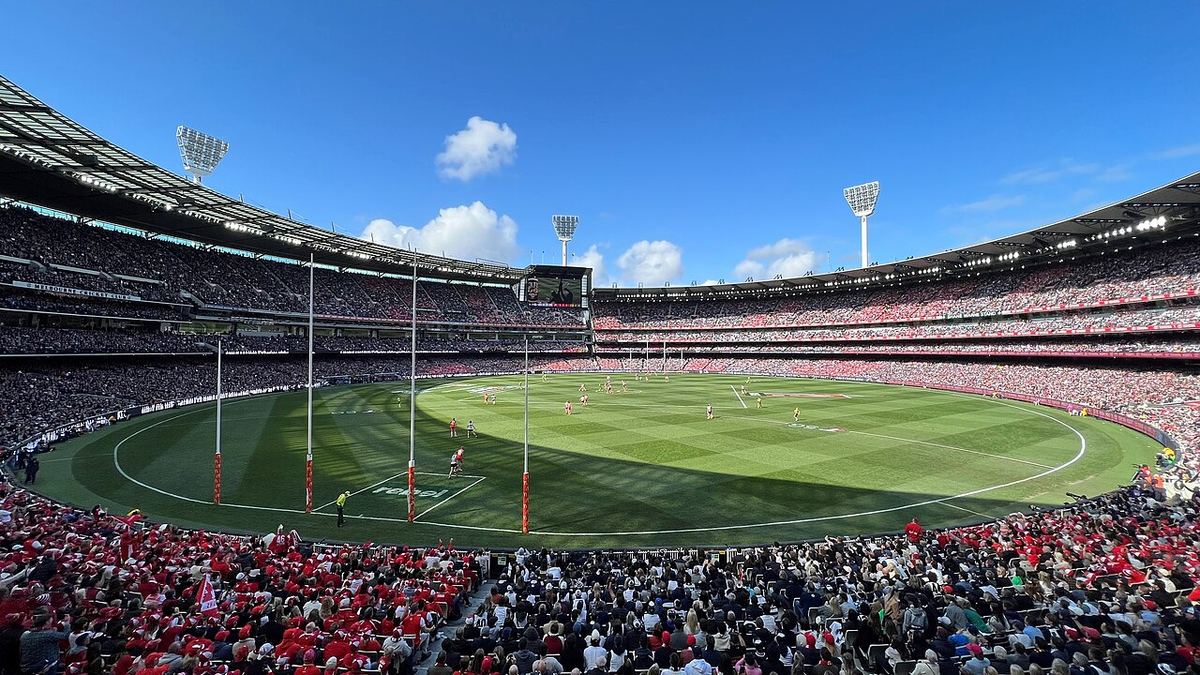
The opening bounce of the 2022 AFL Grand Final at the MCG, 24 September 2022. Photo: Storm machine, CC BY-SA 4.0
On this page 9 sections
- Why the regulator flags multis
- Step 1: turn each price into an implied probability
- Step 2: find the overround and the fair price
- Step 3: the expected return of each leg alone
- Step 4: multiply the legs and watch the margin compound
- Step 5: why legs from the same match are repriced
- Step 6: the full three-leg ticket
- Reading a same-game multi before you place it
- Limits that sit outside the maths
Why the regulator flags multis
The Victorian Gambling and Casino Control Commission puts it bluntly on its How gambling works page: multi bets "promise bigger payouts but have much lower odds than single bets", and "most multi bets don't win making them more profitable for betting companies". Its sports betting page describes multis as "high payouts but low chance of success". The calculation below shows the mechanism behind those statements. Every price, probability and match in it is our own illustration, not a quote from any operator.
One legal point frames the product. The ACMA explains that the Interactive Gambling Act 2001 bans online in-play sports betting, so a same-game multi placed through an app or website is a pre-match bet. Once the match starts, the bet can no longer be placed online.
Step 1: turn each price into an implied probability
Decimal odds convert to implied probability with one division: 1 / odds. A $2.00 price implies 50%, a $1.60 price implies 62.5%. If you need a refresher on decimal prices, our guide to reading Australian odds walks through it.
Here are three illustrative two-way markets for one AFL match, with the implied probability of each side.
| Market | Selection A | Implied | Selection B | Implied | Book total |
|---|---|---|---|---|---|
| Head to head | Home side $1.60 | 62.50% | Away side $2.40 | 41.67% | 104.17% |
| Total points | Over $1.90 | 52.63% | Under $1.90 | 52.63% | 105.26% |
| Player 2+ goals | Yes $2.10 | 47.62% | No $1.70 | 58.82% | 106.44% |
Step 2: find the overround and the fair price
In a fair book, the probabilities of all outcomes would add to exactly 100%. The excess over 100% is the overround, and it is the bookmaker's built-in edge. In the table it is 4.17% on the head to head, 5.26% on the total and 6.44% on the player market.
To estimate the fair probability, divide each implied probability by the book total:
- Home side: 62.50% / 1.0417 = 60.00%, a fair price of $1.667
- Over: 52.63% / 1.0526 = 50.00%, a fair price of $2.00
- Player 2+ goals: 47.62% / 1.0644 = 44.74%, a fair price of $2.235
This proportional method is a simplification; bookmakers do not publish how they spread their margin. It is still the standard way to strip the edge out of a two-way market.
Step 3: the expected return of each leg alone
Expected return per $1 is the price you get multiplied by the fair probability.
- Home side: $1.60 x 0.6000 = $0.960
- Over: $1.90 x 0.5000 = $0.950
- Player 2+ goals: $2.10 x 0.4474 = $0.940
Each single bet hands back somewhere between 94c and 96c of every dollar staked over the long run. That is the cost of one leg.
Step 4: multiply the legs and watch the margin compound
If the three outcomes were unrelated, a standard multi would pay the product of the prices: 1.60 x 1.90 x 2.10 = $6.384. The fair price is the product of the fair prices: 1.667 x 2.00 x 2.235 = $7.451.
The expected return is the product of the per-leg returns: 0.960 x 0.950 x 0.940 = $0.857. A punter now gives up about 14.3c in the dollar, against 4c to 6c on any one leg. The margin did not add up across the legs; it multiplied. A fourth leg at a similar 95c return would take the figure to roughly 0.857 x 0.95 = $0.814.
Step 5: why legs from the same match are repriced
Multiplying prices only works when the outcomes are independent. Legs from one match rarely are. Suppose the player in our example plays for the home side. If the home side wins, it has probably kicked a winning score, and its forwards are more likely to have kicked goals. The outcomes are positively correlated.
Assume, for illustration, that the chance of the player kicking 2+ goals rises from 44.74% overall to 52% in games the home side wins. The true joint probability of both legs is then 0.60 x 0.52 = 31.2%, not the 0.60 x 0.4474 = 26.8% that independent pricing assumes.
If a bookmaker simply multiplied the two prices, the bet would pay 1.60 x 2.10 = $3.36, and the expected return would be 3.36 x 0.312 = $1.048. That is an edge to the punter, which is exactly what a same-game pricing engine is built to prevent. So the combined price is cut. Say the app offers $2.90 for the pair: expected return 2.90 x 0.312 = $0.905, an implied probability of 34.5% against a true 31.2%.
Correlation can also run the other way. Legs that pull against each other, such as the away side winning and a home forward kicking a bag, can be priced longer than the plain product. The engine adjusts in both directions; the margin stays in place either way.
Step 6: the full three-leg ticket
Add the over leg, which for simplicity we treat as unrelated to the other two. True probability of all three: 0.312 x 0.50 = 15.6%. Suppose the same-game multi is offered at $5.50, an implied 18.2%.
- Expected return: 5.50 x 0.156 = $0.858 per $1.
- Expected loss: about 14.2c per $1 staked.
- Chance the ticket loses: 1 - 0.156 = 84.4%.
That last line lines up with the regulator's warning. Even when every leg looks likely on its own, the ticket loses far more often than it wins.
Reading a same-game multi before you place it
- Price each leg as a single first and note its implied probability.
- Ask whether the legs help or hurt each other; that tells you which way the engine has adjusted.
- Count the legs. Each added leg multiplies in another margin.
- Compare the offered price with the product of the singles. A large gap usually means strong correlation, not generosity.
- Treat bonus boosts as a change to one price, and redo the sum.
These checks pair with the staking ideas in our notes on betting strategy, and the wider mechanics of markets are covered in our sports betting primer.
Anyone treating multis as an income plan should read what living off betting involves in Australia first.
Limits that sit outside the maths
Long-shot tickets are where chasing starts, because a near miss on a five-leg multi feels like a near win. BetStop, the National Self-Exclusion Register, lets you block yourself from all licensed Australian online and phone wagering providers at no cost, and the free Gambling Helpline on 1800 858 858 is open 24 hours a day. Our responsible gambling page has the state-by-state contacts.
Sources
Frequently asked questions
Why does a same-game multi pay less than multiplying the odds?
Legs from one match are often positively correlated, so the chance of them all landing together is higher than the product of the single-leg chances. The pricing engine shortens the combined price to account for that and keep its margin.
How do I work out the bookmaker margin in a market?
Convert each price to implied probability with 1 divided by the decimal odds, add them up, and subtract 100%. Two runners at $1.90 each add to 105.26%, so the overround is 5.26%.
Can I place a same-game multi during the game online?
No. The ACMA explains that the Interactive Gambling Act 2001 bans online in-play sports betting, so same-game multis placed online are pre-match bets.
Do more legs make a same-game multi worse value?
On average, yes. Each leg carries its own margin and the margins multiply, so a ticket returning 96c, 95c and 94c per leg returns about 86c per dollar in total.
Read next
 RacingTote vs Fixed Odds in Australian Racing, ExplainedA tote dividend is a share of a pool after commission, while a fixed price is a promise made when the bet is struck. We set the two side by side…
 TraditionsTwo-up Rules, Odds and Where the Game Is LegalTwo pennies, a wooden kip and a crowd around a ring. We walk through a spin from the boxer's call to the payout, work out the odds of heads, tails…
 Law & TaxWhy the ACMA Blocks Gambling Websites and What It MeansA blocked gambling page is the end of a legal process that starts with a complaint and ends with a request to internet providers. We explain which…
18+Order set by our editors; we earn a commission on sign-ups through partner links — how this works. Decide your budget and session time before you start.