Guides
How two-up works and where you can play
Two-up looks like chaos the first time you push into a ring, but the game has a fixed order and very simple maths. We worked through it the way a newcomer meets it: who does what, what a throw can produce, why the side bets are close to a fair coin, and then the part most guides skip, which is exactly where and when each state allows the game.
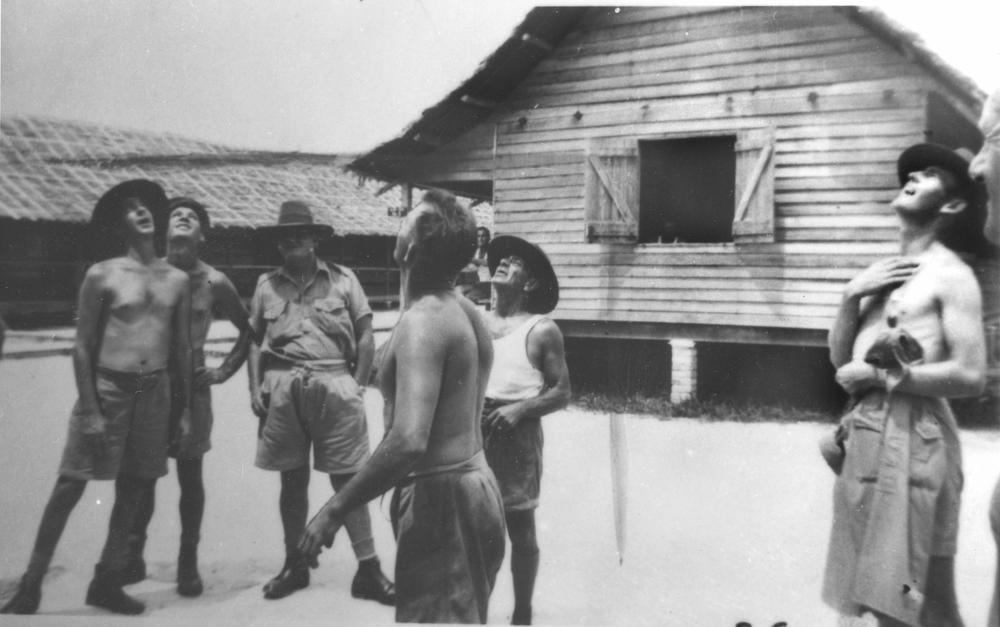
Australian Imperial Force soldiers playing two-up in a camp compound, 1941. Photo: Truth (Brisbane, Qld.), Public domain
On this page 5 sections
The people and the gear
RSL Queensland, which publishes a plain-language guide for its sub-branches, uses the same vocabulary you will hear in any ring. The spinner is the punter throwing the pennies. The boxer (also called the ringkeeper) takes and pays the spinner's bet and makes sure the game is run fairly; the boxer's decision is final. The kip is the flat paddle the pennies sit on before the throw. The ring is the marked space where the coins must land, and the school is the crowd betting around it.
There are only three results. Heads means both pennies show the monarch's head. Tails means both show the reverse. Odds means one of each, and odds settle nothing.
A spin from start to finish
The sequence below follows the order described by RSL Queensland. House rules on details such as stake sizes vary from venue to venue, so the boxer's call on the night always wins.
- The boxer picks a spinner. The spinner places a bet, and the boxer finds another player to cover it with an opposing bet of the same amount.
- The school bets among itself. Side bets are struck player to player around the ring, one punter backing heads and another backing tails for the same amount. RSL Queensland notes typical side bets of $5 to $20.
- The coins go on the kip tails-up. Two pennies are laid on the kip with the tails side showing.
- The throw. The spinner tosses both pennies at least 3 metres into the air.
- The ruling. Two heads or two tails landing inside the ring settle all bets. Odds, a coin on its edge, or a coin outside the ring means a rethrow, with every bet left standing.
- Settling. The spinner can only win by throwing heads. Tails ends the spinner's bet and the kip passes on. Side bets are paid directly between the two players who struck them.
The maths of a single throw
Each penny lands heads or tails with probability 1/2, and the two coins are independent. That gives four equally likely outcomes: HH, HT, TH and TT.
- Heads (HH): 1 outcome in 4, so 1/4 or 25%.
- Tails (TT): 1 in 4, so 25%.
- Odds (HT or TH): 2 in 4, so 50%.
Because odds is simply thrown again, what matters for betting is the chance of heads given that the throw counts: 0.25 ÷ (0.25 + 0.25) = 0.5. Heads and tails are a true 50/50.
How long a decision takes
Half of all throws are odds, so a throw settles the bet with probability 0.5. The expected number of throws per decision is 1 ÷ 0.5 = 2. A run of odds is common: three in a row has probability 0.5 × 0.5 × 0.5 = 1/8 (12.5%), and five in a row 1/32, about 3.1%. Long odds runs are normal chance, not a sign of a rigged kip.
Why a traditional ring has no house edge
A side bet of $10 on heads against $10 on tails pays even money on a 50/50 event. The expected value is 0.5 × (+$10) + 0.5 × (−$10) = $0. Nobody is building in a margin, which is the opposite of a casino table, where the payout is set slightly below the true odds. Our page on which casino games return the most shows how that margin looks on roulette and blackjack.
The no-edge rule holds only where no commission is taken, and the states treat that differently. Western Australia's two-up policy says that, unless a permit condition prohibits or restricts it, the ring keeper may take a customary commission of up to 10% of the spinner's winnings (after the spinner withdraws) and of the winnings of players who bet through the ring keeper and win on heads. Work that through for a $10 heads bet placed via the ring keeper: a win pays $10 less 10%, so $9, and a loss costs $10. The expected value is 0.5 × $9 − 0.5 × $10 = −$0.50, a 5% edge against the punter. In Queensland, by contrast, the government's guidance says all money wagered must be returned to players as winnings and no commission can be charged.
The spinner's run
A spinner who stays in for several heads needs each to come before a tails. Since every counted throw is 50/50, two heads in a row is 1/4 and three heads in a row 1/8. Odds throws in between change nothing; they only add time.
Where and when it is legal
Outside the exemptions below, the game is unlawful gambling. Each exemption has its own days, venues and money rules, which is why the same game is run differently in Perth, Hobart and Sydney. Our overview of gambling law across the states covers the wider framework.
State and territory exemptions, from the legislation or regulator guidance listed in the sources.
| Jurisdiction | When | Where and conditions |
|---|---|---|
| New South Wales | Anzac Day (25 April) and commemorative days: 15 August, and 11 November after 12 noon | Gambling (Two-up) Act 1998, s 4A and s 6. Broken Hill is the one place in the state where the game runs all year at approved venues. |
| Victoria | RSL sub-branches: Anzac Day and the seven days before. Hotels, clubs and other venues: Anzac Day only | RSL Victoria must approve every game; non-RSL venues also need endorsement from a local RSL sub-branch (VGCCC). |
| Queensland | Anzac Day (25 April) or another day legally designated for remembrance of ex-service men and women | Licensed RSL or services clubs; other licensed premises need written permission from an RSL sub-branch. No commission, all money returned as winnings, no players under 18. Any entry fee goes to the RSL for veterans and their families (Charitable and Non-Profit Gaming Act 1999). |
| South Australia | Anzac Day | Premises of an RSL branch or sub-branch, or premises owned or occupied by the Defence Forces. The exemption does not apply if any payment is sought for the right to take part (Anzac Day Commemoration Act 2005, s 19). |
| Western Australia | Anzac Day permits for RSL clubs; other permits year-round outside 100 km of Crown Perth | Ministerial permit under s 48 of the Gaming and Wagering Commission Act 1987, applications by 1 March, no fee. Commission of up to 10% may be taken unless the permit says otherwise. RSL Queensland notes the Kalgoorlie school runs all year under a special licence. |
| Tasmania | 6am to 6pm on 25 April | Declared an exempt game by the Tasmanian Liquor and Gaming Commission on 4 September 2024; premises permanently occupied by an organisation whose members are mostly former defence force members. |
| ACT | Anzac Day | Per RSL Queensland's summary: with the venue's permission, and no charge, commission or fee unless the money goes to charity. |
| Northern Territory | Anzac Day | Per RSL Queensland's summary: run by or on behalf of an RSL club, with profits payable to that club. |
For the ACT and the Northern Territory we could not open a current regulator page, so the table relies on RSL Queensland's state summary; check with the ACT Gambling and Racing Commission or the NT regulator before running a game there.
Details that trip people up
- Western Australia counts hours. A standard permit outside the Perth radius allows a maximum of six hours of play, and only two coins or two dice may be used. No admission charge may be made and under-18s may not play or help run the game.
- Victoria counts days. The seven-day lead-in belongs to RSL sub-branches only; a pub gets Anzac Day itself and nothing else.
- Tasmania counts the clock. A game still running at 6.01pm on 25 April is outside the exemption.
- New South Wales counts the calendar. 11 November is covered only after 12 noon.
Keeping the day in proportion
The game is short, loud and social, and most of the money changes hands in $5 and $20 notes. The maths still applies: a 50/50 bet repeated all afternoon has no way to come out ahead on average, and a commission ring is slightly worse. Set a cash amount before you walk in and leave the cards at home. If a day at the ring turns into chasing losses, Gambling Help Online runs a free, confidential line on 1800 858 858, open around the clock, and our safer gambling page lists the other tools available in Australia.
Online, the coin is replaced by software. If you ever see a digital version, the fairness question becomes one about the random number generator, which we explain in our guide to how casino RNGs are tested.
Sources
- Gambling (Two-up) Act 1998 (NSW)
- VGCCC: Two-up on Anzac Day
- Business Queensland: Two-up on Anzac Day
- Anzac Day Commemoration Act 2005 (SA)
- Gaming and Wagering Commission of WA: Two-up policy
- Tasmanian Liquor and Gaming Commission: ANZAC Day Two Up, conditions of exempt game
- RSL Queensland: Two-up, an Anzac Day tradition
Frequently asked questions
Why is two-up only legal on Anzac Day?
The game is unlawful gambling in every state and territory except under specific exemptions. Those exemptions were written to keep a wartime tradition alive on Anzac Day, and in some states on other commemorative days, at RSL and similar venues.
What happens when the coins land odds?
Nothing is settled. One head and one tail is called odds, and the spinner throws again with all bets standing. Half of all throws are odds, so a decision takes two throws on average.
Can you play two-up all year anywhere in Australia?
Broken Hill in New South Wales allows the game all year at approved venues, and RSL Queensland notes that the Kalgoorlie school in Western Australia runs year-round under a special licence.
Does the house take a cut in two-up?
It depends on the state. Queensland requires all money to go back to players with no commission. Western Australia's policy allows a ring keeper to take up to 10% of certain winnings unless the permit restricts it.
Read next
 Law & TaxWhy the ACMA Blocks Gambling Websites and What It MeansA blocked gambling page is the end of a legal process that starts with a complaint and ends with a request to internet providers. We explain which…
 Safer GamblingBetStop Self-Exclusion: Coverage, Periods and Exit RulesBetStop shuts every licensed online and phone wagering account in one go, but it does not reach pokies rooms or casinos. We map what the national…
 Safer GamblingCashless Pokies in NSW, Victoria and TasmaniaCashless pokies have been promised, trialled, legislated and shelved, depending on the state. We sort the announcements from what is actually in…
18+Order set by our editors; we earn a commission on sign-ups through partner links — how this works. Decide your budget and session time before you start.