Guides
How each-way bets pay on Australian races
Each-way is the bet most racegoers reach for when they like a horse but not quite enough to back it to win. We read the TAB and TABtouch rules on how many places are paid, what happens after scratchings and dead heats, and how tote and fixed-odds place bets differ, then worked the numbers on four $10 examples to see when the bet earns its double stake.
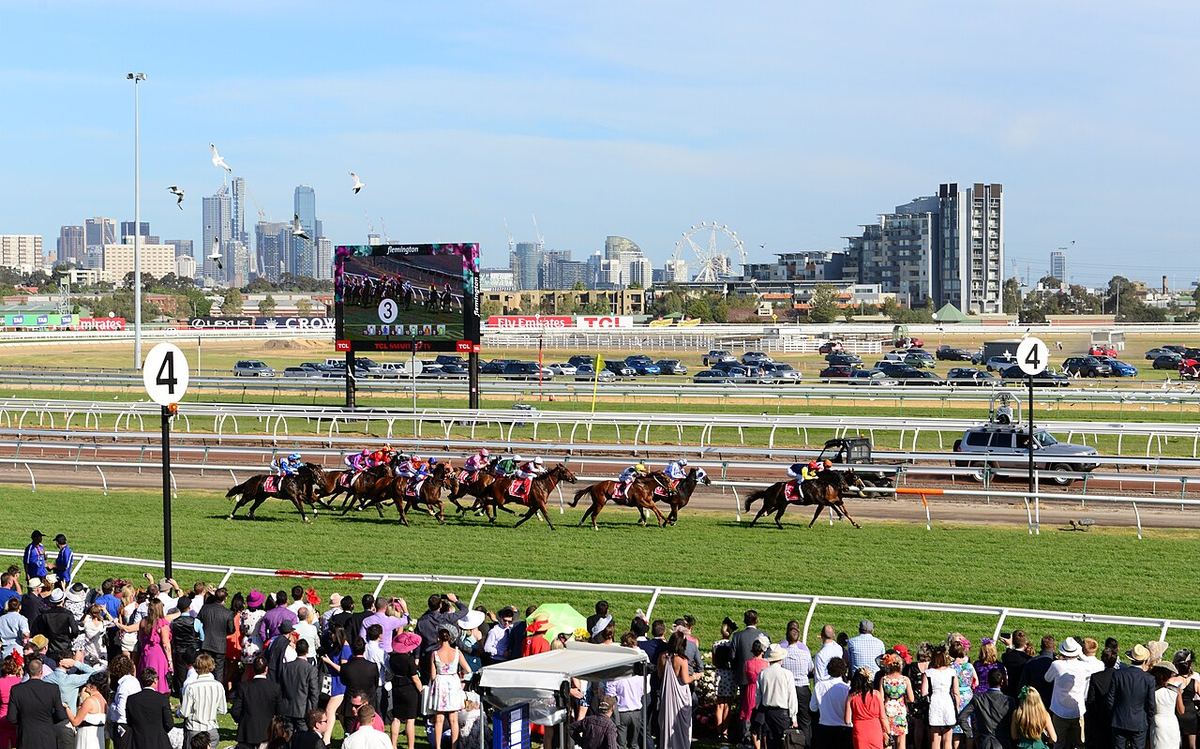
Runners in the last race on Melbourne Cup day, 5 November 2013, at Flemington. Photo: Chris Phutully from Australia, CC BY 2.0
On this page 6 sections
Two bets for the price of two
The TAB's bet-types page defines an Each Way bet as a combination of a Win and a Place bet: if the runner wins you collect both the Win and Place dividends, and if it runs second or third you collect the Place dividend only. TABtouch's beginner guide puts the cost plainly: "$5 each way" means $5 on the win and $5 on the place, so $10 in total. A $10 each-way bet costs $20.
That doubling is the first thing to keep in mind. The place half has to earn back not only its own stake but, when the horse loses, the lost win stake as well.
How many places are paid
Australian place terms are set by the number of starters, not by the bookmaker's mood. TABtouch's Win & Place rules lay them out, and the TAB adds that third-place dividends are paid only in fields of eight or more.
Place terms on TAB and TABtouch by field size, tote and fixed odds compared.
| Situation | Tote place | Fixed-odds place |
|---|---|---|
| 8 or more starters | 3 places paid | 3 places paid |
| 5 to 7 starters | 2 places paid | 2 places paid |
| 4 or fewer starters | No place betting | No place betting |
| Late scratchings shrink the field | Number of placings unchanged; the TAB still pays 3 places if the field drops to 5, 6 or 7 | Placings that applied when the bet was struck, but deductions may apply |
| Field falls below 5 starters | Place bets refunded | Per the operator's fixed-odds rules |
| Dead heat | Dividend split; $1.00 minimum per dead-heat runner | Dividend split; no minimum |
| Price | Fluctuates until the pool closes | Set when the bet is struck |
Fixed-odds place is not universal either: TABtouch says it is offered on the vast majority of Australian races, which leaves some where the tote is the only place market.
Four worked examples
All four use a $10 each-way bet, $20 outlay. Dividends are illustrative, per $1.
1. A mid-priced runner: win $8.00, place $2.60
- Wins: $10 × $8.00 + $10 × $2.60 = $80 + $26 = $106. Profit $86.
- Second or third: $10 × $2.60 = $26. Profit $6.
- Unplaced: $0. Loss $20.
This is the shape each-way was built for: placing still shows a small profit. The win half carries the upside, and the place half pays for the insurance when the horse runs second or third.
2. A short favourite: win $2.20, place $1.15
- Wins: $22.00 + $11.50 = $33.50. Profit $13.50.
- Second or third: $11.50. Loss $8.50.
- Unplaced: loss $20.
Here the place half only softens a loss. The general rule falls out of the arithmetic: placing returns $10 × P against a $20 outlay, so you break even only when the place dividend P is $2.00 or more. Below $2.00, a placing is still a losing result.
3. A dead heat for third: place $3.00
Under TABtouch's rules a dead heat between two horses halves the dividend, and between three it pays a third. A $3.00 place split two ways becomes $1.50, so the place half returns $15 and the bet loses $5 overall. Now take a horse with a $1.60 place dividend in the same dead heat. Half is $0.80. On the tote the $1.00 minimum per dead-heat runner applies, so $10 back; on fixed odds there is no minimum, so $8 back.
4. Seven starters, horse runs third
With five to seven starters only two places are paid, so third collects nothing and the full $20 is lost. The trap is a field that was eight when you looked and seven at the jump. For tote bets, TABtouch says late scratchings do not change the number of placings, and the TAB confirms three place dividends are still paid if late scratchings cut the field to five, six or seven. For fixed-odds bets the placings that applied when you struck the bet stand, but a scratching can bring a deduction from your return.
What the tote keeps
TABtouch publishes its commission for pools combined with One Pool or run standalone in WA: 14.50% on Win and 14.25% on Place. At pool level, $100 bet into the Win pool returns $85.50 to winners and $100 in the Place pool returns $85.75. Apply that to a $10 each-way bet placed into average pools: $10 × 14.50% = $1.45 plus $10 × 14.25% = $1.425, total $2.875, or 14.375% of the $20 outlay. That is the long-run cost of the bet type before any skill or luck; no choice between win and place halves removes it. Our guide to reading odds and implied probability explains how the same idea shows up in fixed-odds prices.
When each-way is poor value
- Short-priced favourites. If the place dividend is likely to be under $2.00, a placing loses money. Example 2 shows the scale.
- Fields of five to seven. Only two places are paid, so the place half has a much narrower target.
- Fields of four or fewer. There is no place betting at all.
- Crowded finishes. Dead heats halve or third the place dividend, and on fixed odds there is no floor.
- When you simply fancy the horse to win. Half the money goes on an outcome you did not believe in. Our staking strategy notes cover how to size a win-only bet instead.
Each-way works best on longer-priced runners in fields of eight or more, where a placing alone can cover the double stake. For a refresher on how win, place and exotic bets fit together, see our betting basics explainer.
Keeping it a day out
Each-way feels safe because it often returns something, but example 2 shows that returning something is not the same as winning. Set the day's total before the first race and treat every each-way bet as $20, not $10. If racing stops feeling like a day out, BetStop, the Australian Government's free national self-exclusion register, blocks you from all licensed Australian online and phone gambling providers, and Gambling Help Online offers free, confidential support on 1800 858 858. Our safer gambling page has more on deposit limits.
Sources
Frequently asked questions
How many places are paid on an Australian horse race?
On the TAB and TABtouch, three places are paid with eight or more starters and two with five to seven. With four or fewer starters there is no place betting.
How much does a $10 each-way bet cost?
It costs $20: $10 on the win and $10 on the place. If the horse wins you collect both dividends; if it runs a place you collect the place dividend only.
What happens to an each-way bet in a dead heat?
The place dividend is halved for a two-way dead heat and split three ways for a three-way one. Tote dividends carry a $1.00 minimum per dead-heat runner on TABtouch; fixed odds have no minimum.
Do late scratchings change the number of places paid?
Not for tote bets. The TAB still pays three place dividends if late scratchings reduce the field to five, six or seven. Fixed-odds bets keep the placings from when the bet was struck, but deductions may apply.
Read next
 Betting MathsFlexi Betting Maths for Trifectas and First FoursEvery exotic bet is a count of combinations multiplied by a unit, and flexi simply lets you shrink the unit. We set out the formulas, a combinations…
 TraditionsFooty Tipping Rules: Scoring, Tiebreakers and Prize MoneyMost office tipping comps fall apart over the same three questions: what a draw is worth, who wins a tie and where the entry money goes. We compare…
 Law & TaxDo You Pay Tax on Gambling Winnings in Australia?A big collect at the TAB or a lotto win usually never reaches your tax return, but there are exceptions. We work through the ATO's guidance, the…
18+Order set by our editors; we earn a commission on sign-ups through partner links — how this works. Decide your budget and session time before you start.