Guides
Working out flexi percentages and combinations
Exotic bets look expensive until you see that the price is just arithmetic: count the combinations, choose how much of a $1 unit you want on each, and the tote does the rest. We worked through the formulas the TAB and TABtouch use, built a combinations table for common boxes, and calculated what a flexi bet returns when it lands, when a runner is scratched and when there is a dead heat.
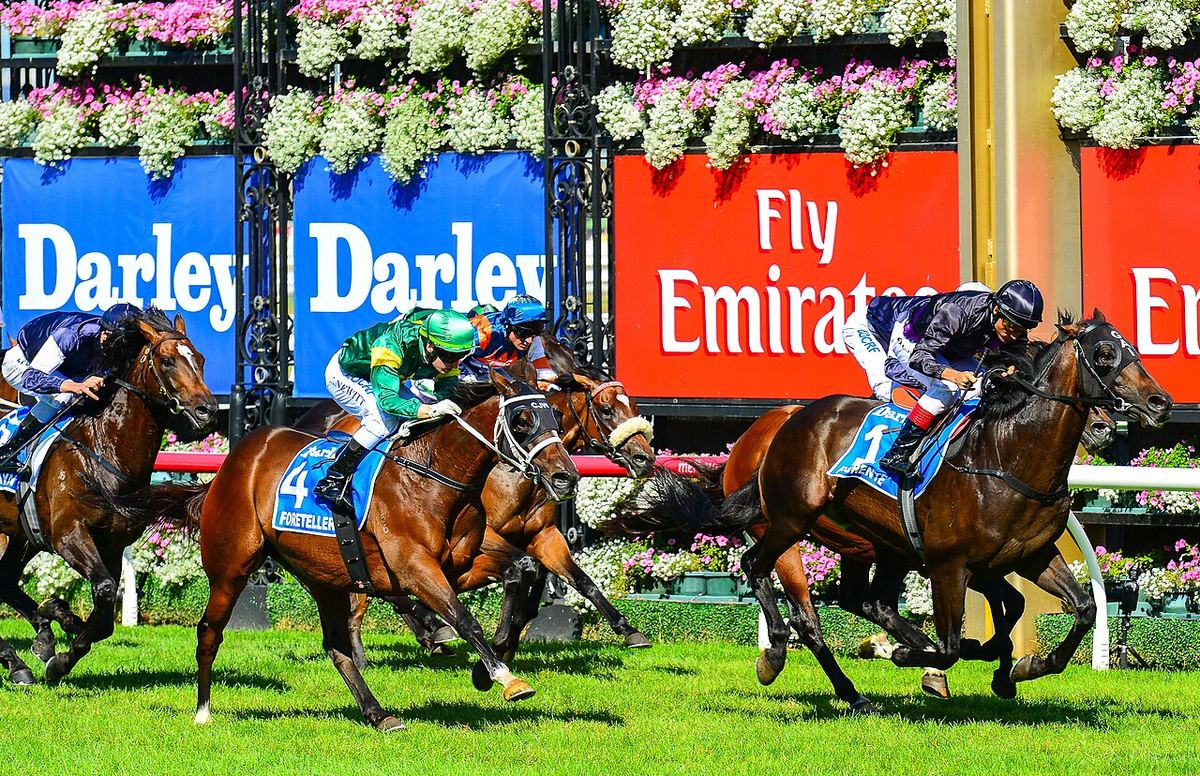
Fiorente and the chasing pack reach the line in the Australian Cup at Flemington, March 2014 (Super Saturday). Photo: Chris Phutully from Australia, CC BY 2.0
On this page 6 sections
The one formula behind flexi
The TAB's help page explains flexi with a single example: box five runners in a Trifecta for $15. The same bet at the full $1 unit would cost $60, so the $15 bet is 25% of the full price, and if the Trifecta pays a $200 dividend the bet collects 25% of it, $50. Everything else in this article follows from that.
Flexi % = stake ÷ (number of combinations × $1) × 100
Return = declared dividend for $1 × flexi %. TABtouch describes the same calculation as your total spend divided by the number of combinations, and both operators set a floor: the TAB says the percentage must be 1.00% or more, with a minimum investment of 50c in multiples of 50c, and TABtouch says the percentage must be greater than 1%.
Counting combinations
Racing bets are permutations. Order matters for an Exacta, Trifecta and First 4, and does not matter for a Quinella, which pays if your two runners fill first and second in either order. For a box of n runners:
- Quinella: n × (n − 1) ÷ 2
- Exacta: n × (n − 1)
- Trifecta: n × (n − 1) × (n − 2)
- First 4: n × (n − 1) × (n − 2) × (n − 3)
Combinations for a boxed bet, and the full $1 cost of each, by number of runners in the box.
| Runners boxed | Quinella | Exacta | Trifecta | First 4 |
|---|---|---|---|---|
| 4 | 6 | 12 | 24 | 24 |
| 5 | 10 | 20 | 60 | 120 |
| 6 | 15 | 30 | 120 | 360 |
| 7 | 21 | 42 | 210 | 840 |
| 8 | 28 | 56 | 336 | 1,680 |
| 10 | 45 | 90 | 720 | 5,040 |
Two things stand out. First, a box of four costs the same 24 units in a Trifecta and a First 4, because the fourth runner in a four-horse First 4 box has only one place left. Second, the First 4 column grows far faster: going from six to eight runners triples a Trifecta (120 to 336) but more than quadruples a First 4 (360 to 1,680).
Worked: what your stake buys
- Trifecta, box 6, $30. 120 combinations. $30 ÷ $120 = 25%.
- First 4, box 6, $36. 360 combinations. $36 ÷ $360 = 10%.
- First 4, box 10, smallest legal stake. 5,040 combinations, so 1% needs $50.40. Investments go in 50c steps on the TAB, so the bet becomes $50.50, which is $50.50 ÷ $5,040 = 1.002%.
Boxed versus standout
A box covers every order of every runner. A standout fixes one runner in one place and boxes the rest behind it, which cuts the combination count sharply. TABtouch's Trifecta rules let you build either, plus multiple-leg selections where you choose runners for each place separately; putting every runner in the first column turns it into an Allways bet.
The standout formulas
- Trifecta, one runner to win, k runners for second and third: k × (k − 1).
- First 4, one runner to win, k runners for the other three places: k × (k − 1) × (k − 2).
Cost of covering five runners in a Trifecta, boxed and with one runner stood out on top.
| Structure | Working | Combinations | Flexi % for $15 |
|---|---|---|---|
| Box of 5 | 5 × 4 × 3 | 60 | 25% |
| 1 standout, 4 underneath | 4 × 3 | 12 | 125% |
| 1 roving banker, 4 others | 3 × 4 × 3 | 36 | 41.67% |
| Multiple: 1 / 2,3 / 2,3,4,5 | 2 × 3 | 6 | 250% |
The standout costs a fifth of the box for the same five runners, but it only pays if your top pick wins. The box pays whichever of the five finish in the first three, in any order. That is the whole trade: fewer combinations means a larger share of the dividend, at the price of more ways to miss.
Roving bankers
TABtouch allows up to two roving bankers in a Trifecta and up to three in a First 4. A roving banker must finish somewhere in the places, but not in a fixed spot. With one banker and k others in a Trifecta, the banker can take any of three positions and an ordered pair of the others fills the remaining two: 3 × k × (k − 1). With k = 4 that is 36 combinations, as in the table. With two roving bankers and k others, the bankers can sit in 3 × 2 = 6 ordered positions and any of the k fills the third: 6 × k, so 30 combinations with five others.
Multiple-leg selections
The last row of the table picks runner 1 to win, runners 2 or 3 for second, and runners 2, 3, 4 or 5 for third. If 2 runs second, third can be 3, 4 or 5 (three combinations); if 3 runs second, third can be 2, 4 or 5 (three more). Total six. Count multi-leg bets case by case like this, because a runner listed in two legs cannot fill both.
How the dividend is set
The tote does not quote a price in advance. TABtouch's Trifecta rules say the net pool is divided by the winning investments to determine a declared dividend. A hypothetical: if the net pool after the operator's deduction is $50,000 and $40 in $1 units is held on the winning combination, the declared dividend is $50,000 ÷ 40 = $1,250 for $1. A First 4 box of six at 10% holds 0.1 of a unit on that combination and collects $1,250 × 0.10 = $125.
Because flexi bets hold fractions of units, they also count as fractions in that division. Every flexi bet slightly shrinks everyone else's share, just as a full $1 bet would. Our explainer on how odds and dividends relate covers the fixed-price side of the same idea.
Scratchings and dead heats
Refunds
TABtouch says a refund is paid for every combination eliminated by a scratching. Take the TAB's own example, a $15 box-5 Trifecta at 25%, and scratch one runner. The box shrinks to four runners, 24 combinations, so 60 − 24 = 36 combinations are eliminated. Each was held at 25c, so the refund is 36 × $0.25 = $9. The remaining $6 still covers 24 combinations at 25%. The flexi percentage stays the same; the stake shrinks.
Dead heats
- Quinella: per TABtouch, a dead heat for first does not change the dividend, while a dead heat for second pays 50% on each winning combination.
- Exacta: a dead heat creates more than one winning combination, each paid at 50%.
- First 4: the net pool is split, half to each winning combination. If the winning investment is under $0.50, a carryover applies.
A box that covers both dead-heaters collects on both halves, which is one of the few places where wider coverage pays off twice.
Using the numbers sensibly
Flexi makes a 5,040-combination First 4 affordable for about $50, but the maths does not change: you hold 1% of each line, and most lines lose. A useful habit is to write down the flexi percentage before you confirm, because a bet at 1% will return a hundredth of whatever the declared dividend turns out to be. Our notes on building a staking plan show how to size bets against a fixed budget, and the betting basics guide covers the plain win and place bets that sit alongside exotics.
If exotics start eating the budget for the week, BetStop, the National Self-Exclusion Register, lets you block yourself from licensed Australian online and phone wagering in one step, and Gambling Help Online answers on 1800 858 858 at any hour. Our safer gambling page lists the deposit-limit tools as well.
Sources
Frequently asked questions
How is a flexi percentage calculated?
Divide your stake by the number of combinations, then multiply by 100. A $15 box of five in a Trifecta covers 60 combinations, so it is 25%, and the bet collects 25% of the declared $1 dividend.
What is the minimum flexi percentage on the TAB?
The TAB requires the bet percentage to be 1.00% or more, with a minimum investment of 50c in multiples of 50c. TABtouch says the percentage must be greater than 1%.
How many combinations is a First 4 box of six?
Six times five times four times three, which is 360 combinations. A $36 stake gives 10%.
What happens to a flexi bet if a runner is scratched?
TABtouch refunds every combination eliminated by the scratching. In a $15 box-5 Trifecta at 25%, one scratching removes 36 combinations, so $9 comes back and the bet continues on 24 combinations at 25%.
Read next
 TraditionsFooty Tipping Rules: Scoring, Tiebreakers and Prize MoneyMost office tipping comps fall apart over the same three questions: what a draw is worth, who wins a tie and where the entry money goes. We compare…
 Law & TaxDo You Pay Tax on Gambling Winnings in Australia?A big collect at the TAB or a lotto win usually never reaches your tax return, but there are exceptions. We work through the ATO's guidance, the…
 Betting MathsInstant Scratchies Odds: What a Ticket Returns on AverageThe odds printed on a scratchie count every prize, including the ones that only hand your stake back. We run the numbers on three published prize…
18+Order set by our editors; we earn a commission on sign-ups through partner links — how this works. Decide your budget and session time before you start.