Guides
Writing the Rules for Your Footy Tipping Comp
We compared the help pages of the official AFL and NRL tipping games with the guidance Victorian and NSW regulators give to people running comps, so an organiser can write rules once and avoid the Monday arguments. The two codes settle draws, margins and late entries differently, and the state rules on entry fees and prizes are stricter than many workplaces assume.
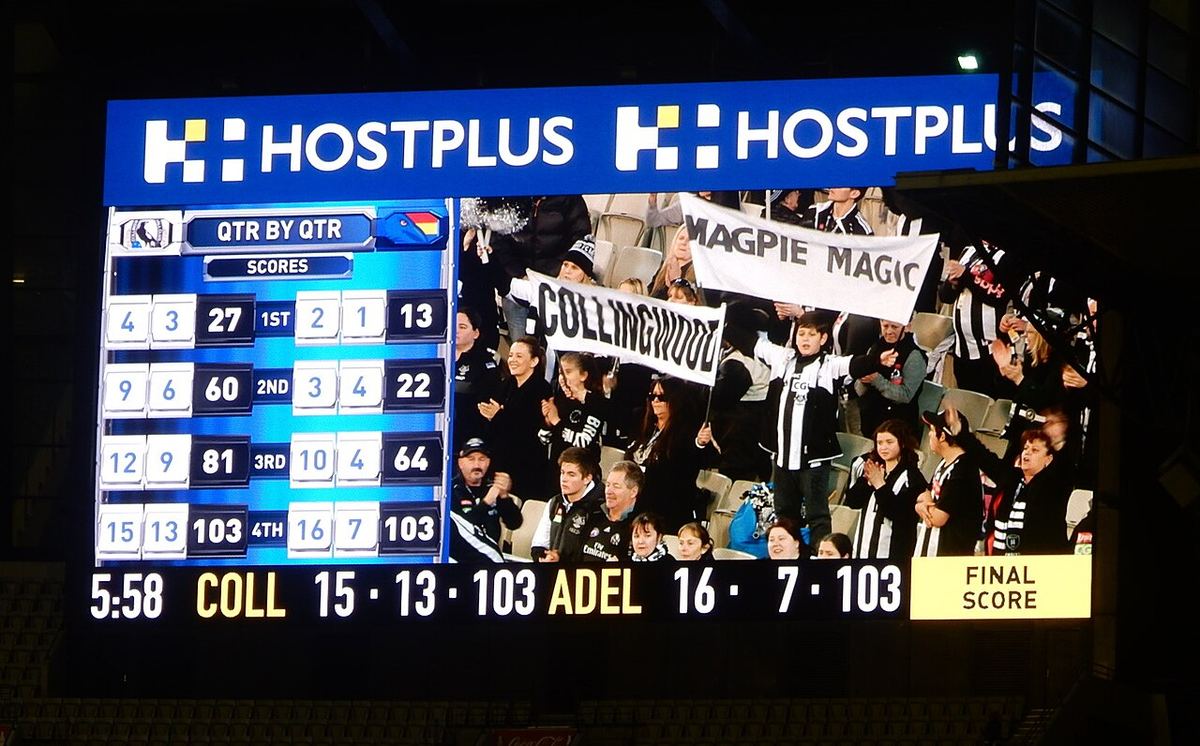
The MCG scoreboard after the drawn Round 19 match between Collingwood and Adelaide, 2017. Photo: Michael Coghlan from Adelaide, Australia, CC BY-SA 2.0
On this page 6 sections
Start with the scoring
Every comp needs a scoring rule that covers the odd results as well as the ordinary ones. The two national codes run official tipping games, and their help pages answer the same questions in slightly different ways. The comparison below sticks to what each page states.
How the official AFL and NRL tipping games score a round.
| Situation | AFL Tipping | NRL Tipping |
|---|---|---|
| Correct tip | 1 point | 1 point |
| Incorrect tip | 0 points | 0 points |
| Drawn match | 1 point | Counted as a win for both teams |
| Cancelled, abandoned or not completed match | Not stated on the help page | Counted as a win for both teams, as is a match with no result declared within 3 days |
| Bonus for tipping every winner | Not stated on the help page | Bonus point in rounds of 8 or more games, not available to anyone who missed a tip |
| Tips lock | At the start of each game | At each match's lock-out |
| Margin tip | First listed match of the round | One randomly selected match per round |
| Missed margin | Average margin prediction score for the team selected | Average of all submitted margins |
| Late joiners | One correct tip for each winning away team in missed rounds | Away-team tips for completed rounds, at most 4 points a round |
The detail on the NRL Tipping help page about rounds with fewer games is a good example of why the edge cases need writing down: there is no bonus point in Round 12, which has only 5 matches.
How the margin tiebreaker works
Both games use a margin prediction to separate players on the same number of correct tips. The AFL Tipping help page explains it with two examples. The Margin Difference is the gap between your predicted margin and the real result, and it accumulates over the season into a Cumulative Margin, where lower is better.
- You tip a team to win by 10 and it wins by 5: the difference is 10 − 5 = 5.
- You tip a team to win by 10 and it loses by 15: the difference is 10 + 15 = 25, because your team was on the wrong side of the result as well as the wrong distance.
Over a season the arithmetic is just addition. A player whose round differences are 5, 25 and 12 carries a cumulative margin of 5 + 25 + 12 = 42 into the next round.
If players are still level, the codes part ways. NRL Tipping goes to the lowest aggregate margin and then to the earliest registration. AFL Tipping settles a remaining tie for a weekly prize in favour of the person who entered their last tip first, that is, whoever went longest without editing. A home comp can borrow either approach, as long as the rule is written before Round 1.
Missed tips and forgetful players
Both games fill gaps automatically. AFL Tipping applies an auto-tip based on each player's Forgot to Tip preference, but anyone whose whole round was auto-tipped cannot win that round's weekly prize. NRL Tipping offers forgotten-tip options including Home Team, The Crowd (the team favoured by most entrants) and Favourites (the team favoured by the NRL's wagering partner at lock-out), with equal cases defaulting to the home team. Players can change the option until the first match of the round locks.
The AFL game also runs side competitions with their own rules. The Gauntlet starts in Round 7: players pick one team each round, can use each team only once, and are eliminated by a loss or a missed tip. A homemade comp does not need extras like this, but if it has any, they need their own tiebreak.
The money side: what state rules say
Once entry fees and prizes are involved, state gaming rules start to apply, and they differ from state to state. Two examples:
Victoria
The VGCCC's footy tipping guidance says no approval from the regulator is needed, because a tipping comp mixes chance with skill. Because there is an element of chance, all money collected must be returned as prizes, and no expenses can be taken out. A set entry fee is not betting, but a comp that involves betting is illegal; betting is legal only through a licensed operator such as Tabcorp. The prizes and the entry fee must be explained before people enter. The VGCCC says the most common method is prizes for the top three tipsters over the season, with weekly prizes for tipping all winners in a round, and that workplace comps have no set guidelines. Anyone planning a commercial-scale comp run over the internet or by text message is told to get legal advice about the Interactive Gambling Act 2001.
New South Wales
The NSW Government's community gaming page on lotteries treats tipping competitions as progressive lotteries, which anyone can run for any purpose. Money payable as a prize cannot exceed $7,000, and an authority from NSW Fair Trading is needed if the total prize value exceeds $30,000. The rules must say that participants predict outcomes, that points are awarded, that prizes are wholly distributed under the rules, and whether periodical prizes are awarded. The person conducting the comp, or managing the organisation that benefits, cannot take part. Children can join unless the rules set an age limit.
A free comp run by a business to promote itself is a different category, a trade promotion. The NSW trade promotions page says these cannot charge an entry fee, need an authority above $10,000 in total prize value, and limit liquor prizes to no more than 20 litres at 20% alcohol or less, or 5 litres above 20%. If the rules give no timeframe, unclaimed prizes must be kept for at least 3 months.
Worked prize split
Take a Victorian office comp with 20 entrants paying $20 each. The pot is 20 × $20 = $400, and under the VGCCC guidance all $400 goes back as prizes, with nothing kept for running costs. A common top-three split of 60%, 25% and 15% gives:
- First: $400 × 0.60 = $240
- Second: $400 × 0.25 = $100
- Third: $400 × 0.15 = $60
Check: $240 + $100 + $60 = $400. If the comp also pays weekly prizes, take them out of the same pot and say so in the rules before anyone pays.
Checklist for the rules sheet
- Entry fee, payment deadline and who holds the money.
- Every prize, in dollars or percentages, published before entries close.
- Confirmation that all entry money is paid out (required in Victoria).
- Points for a correct tip, a draw and a cancelled or abandoned match.
- When tips lock: start of each game, or start of the round.
- What happens to a missed tip, and whether an auto-tipped round can win a weekly prize.
- Which match carries the margin tip and how a missed margin is scored.
- The tiebreaker order, down to the last resort.
- How late joiners are credited for rounds they missed.
- Who can enter, including any age limit, and whether the organiser can play (in NSW, they cannot).
- No side bets run through the comp; wagering belongs with licensed operators only.
That last point matters. A tipping comp is a social contest, not a betting market, and the line blurs quickly when punters start putting money on the side. Our explainer on how sports betting works covers the difference, and our piece on reading the odds explains what a favourite actually means when you tip one.
Betting is for adults 18 and over; if a comp starts leading to bigger wagers, the National Gambling Helpline on 1800 858 858 and the national BetStop register are both there, and our safer gambling page lists more tools.
Sources
Frequently asked questions
How many points is a draw worth in footy tipping?
In the official AFL Tipping game a drawn match scores 1 point. In NRL Tipping a draw is treated as a win for both teams, so every tip on that match counts as correct. A home comp should state its own rule.
How does the margin tiebreaker work?
You predict the winning margin for one nominated match each round. The gap between your prediction and the real result is added up over the season, and the lowest total wins a tie. In AFL Tipping, tipping a team to win by 10 when it loses by 15 counts as a 25-point difference.
Can the organiser keep part of the entry money in Victoria?
No. The VGCCC says that because a tipping competition has an element of chance, all money collected must be returned as prizes and no expenses can be taken out.
Do I need a permit to run a footy tipping comp in NSW?
Tipping competitions are progressive lotteries that anyone can run. An authority from NSW Fair Trading is needed only if the total prize value exceeds $30,000, and money payable as a prize cannot exceed $7,000.
Read next
 Law & TaxDo You Pay Tax on Gambling Winnings in Australia?A big collect at the TAB or a lotto win usually never reaches your tax return, but there are exceptions. We work through the ATO's guidance, the…
 Betting MathsInstant Scratchies Odds: What a Ticket Returns on AverageThe odds printed on a scratchie count every prize, including the ones that only hand your stake back. We run the numbers on three published prize…
 Betting MathsKeno Odds by Number of Spots, Worked OutHow likely is a full catch on a 10-spot, and what does the prize table actually hand back per dollar? We calculated the odds for every spot size from…
18+Order set by our editors; we earn a commission on sign-ups through partner links — how this works. Decide your budget and session time before you start.