Guides
Running an office Cup sweep properly
The office sweep is the one bet many Australians place each year, and it is usually organised on the back of an envelope. We worked through a full sweep with real numbers, from ticket sales to the cheque for last place, then read what the regulators in Victoria, New South Wales, Queensland and South Australia say about who can run one, how big it can be and where the money must go.
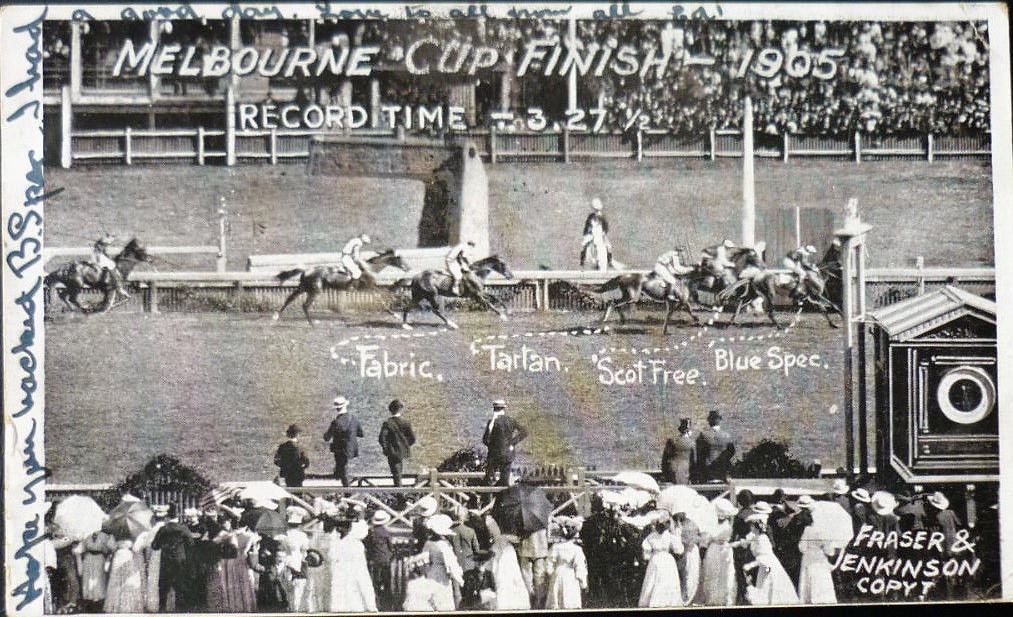
The finish of the 1905 Melbourne Cup at Flemington. Photo: Aussie~mobs from Brisbane, Australia, Public domain
On this page 5 sections
What a sweep actually is
Victoria's gambling regulator, the VGCCC, describes a Melbourne Cup sweep as a lottery in which each entrant is allotted a horse in the race and prizes depend on where that horse finishes. Nobody picks a horse; the draw decides. That is what separates a sweep from a tipping competition or a bet with a bookmaker, and it is also why the law treats it as a lottery rather than as wagering.
The race fits the format neatly because the field has a ceiling. The Victoria Racing Club describes the Cup as offering a capacity 24-horse field, and the race is run on the first Tuesday in November, which in 2026 is 3 November. Twenty-four horses means twenty-four tickets.
The worked calculation
We built the example most offices use: 24 tickets at $5 each, with prizes for first, second, third and last.
Step 1: the pool
24 tickets × $5 = $120. In Victoria the regulator is explicit that the organiser cannot retain any money for costs or expenses, so the whole $120 goes back out as prizes.
Step 2: the split
The VGCCC says the most common approach pays first, second, third and last, though other placings are allowed, and that the prize list must be finalised and clear to entrants before the sweep starts. A split we would put on the sign-up sheet:
Prize split for a 24-ticket, $5 sweep (pool $120).
| Place | Share | Working | Prize |
|---|---|---|---|
| 1st | 60% | $120 × 0.60 | $72.00 |
| 2nd | 20% | $120 × 0.20 | $24.00 |
| 3rd | 10% | $120 × 0.10 | $12.00 |
| Last | 10% | $120 × 0.10 | $12.00 |
| Total | 100% | $120.00 |
The shares add to 100%, which is the check that matters: if the column does not total the pool, someone is keeping money they should not.
Step 3: what a ticket is worth
Each ticket has a 1 in 24 chance at each prize. The chance of collecting anything is 4 ÷ 24 = 1 in 6, about 16.7%. The expected return on a $5 ticket is ($72 + $24 + $12 + $12) ÷ 24 = $120 ÷ 24 = $5.00. A sweep run with no deduction is a zero-sum game: on average every entrant gets their $5 back, which is a better deal than any bet with a bookmaker or the TAB, where a margin is built into the price. Our explainer on reading racing prices shows where that margin sits.
Step 4: when a horse is scratched
Horses come out of the Cup after the field is set, and the VGCCC accepts two ways to handle it, provided entrants are told in advance.
- All-in, no refunds. The holder of the scratched horse loses their $5. The pool stays at $120 and the table above is unchanged.
- Refund and re-split. The scratched ticket is refunded and the pool drops to 23 × $5 = $115. Apply the same shares: 1st $69.00 ($115 × 0.60), 2nd $23.00, 3rd $11.50 and last $11.50. Total $115.00.
Under the refund method a ticket's expected value stays at exactly $5 ($115 ÷ 23). Under all-in, the 23 surviving tickets share $120, so each is worth $120 ÷ 23, about $5.22, and the unlucky entrant wears the loss. Neither is wrong; changing method after the draw is.
Step 5: bigger offices
With 48 people, the usual fix is two sweeps of 24 rather than one sweep where each horse is sold twice. Two separate sweeps keep the arithmetic above intact. If you must sell each horse twice, the prize for a place is split between the two holders, so every figure in the table halves per person while the pool doubles to $240.
What the regulators say
A sweep is legal in most places only because each state carves social and small lotteries out of its general ban. The carve-outs are not identical. For the broader picture, see our guide to gambling law across Australia.
Victoria
The VGCCC sets three hard rules: all the money collected is returned as prizes, the organiser keeps nothing for costs, and the total value of prizes must not be more than $5,000. There is no minimum or maximum entry fee and a sweep can be run anywhere, including a workplace or a pub. A sweep can also be run on other races, such as the Caulfield Cup. Calcutta sweeps, where horses are auctioned, are a different product that a club can run only under a permit from the Minister for Racing.
New South Wales
The NSW Government's community gaming page says anyone can conduct a sweep for social entertainment. For a social sweep, all proceeds must be paid to the players holding the winning tickets. An authority is required only if the total value of all prizes is more than $30,000, and in that case the gaming rules go to NSW Fair Trading at least 10 working days beforehand. The person running the draw, including deciding who wins, cannot enter. Two details surprise people: there is no requirement to keep records, although the page recommends it, and children can take part unless the sweep's own rules set an age limit.
Queensland
Business Queensland lists sweeps, including Calcutta sweeps, among category 1 games, which need no licence where total ticket sales (gross proceeds) are no more than $2,000. Category 1 games are run by non-profit associations and, in limited cases, by individuals, so read the conditions on that page before treating the office sweep as covered. Category 2, also without a licence for eligible bodies, covers proceeds between $2,000 and $50,000.
South Australia
The South Australian Government's sweepstakes guidance says a sweepstake does not need a licence when an organisation runs it on its own behalf, gross proceeds do not exceed $2,000, the prizes include no banned goods or services, and all money collected is used for prizes. The detailed sweepstakes rules sit in the Lotteries Regulations 2021. Our South Australia page covers the state's other gambling rules.
The other states and territories
We could not find a current regulator page on office sweeps for Western Australia, Tasmania, the ACT or the Northern Territory. If you are organising one there, ask the state regulator before you collect money rather than assuming another state's limits apply.
The organiser's checklist
- Fix the ticket price and the number of tickets. One ticket per horse in the final field.
- Write down the prize split as percentages that add to 100%, and post it before anyone pays.
- Choose the scratching rule (all-in or refund) and write it on the same sheet.
- Define last place. Decide in writing what happens if a horse fails to finish, so there is no argument at 3pm.
- Keep nothing. In Victoria the organiser cannot retain money for costs; in NSW a social sweep pays all proceeds to winners.
- Check the cap. $5,000 in prizes in Victoria, $30,000 before an authority is needed in NSW, $2,000 in gross proceeds for the no-licence categories in Queensland and South Australia.
- Do the draw in public after the field is final, with names and horses recorded on one sheet.
- Do not enter your own sweep in NSW if you run the draw.
- Pay out promptly and keep the sheet, even where the law does not require it.
When the sweep is not the end of it
For most people, $5 on a sweep is the whole of their Cup Day gambling. For some, the sweep leads to a betting app and a long afternoon. If that is you, our notes on setting limits are a good starting point, and Gambling Help Online offers free, confidential support on 1800 858 858 at any hour.
Sources
Frequently asked questions
Is an office Melbourne Cup sweep legal?
In Victoria, NSW, Queensland and South Australia a small social sweep is permitted without a licence if it stays inside the state's limits and the prize money goes back to entrants. Victoria caps prizes at $5,000 and bars the organiser from keeping any money.
What happens in a sweep if my horse is scratched?
It depends on the rule set before the draw. Victoria's regulator accepts either keeping all entry money with no refunds or refunding the entrant and changing the prize list, as long as entrants are told.
How should Melbourne Cup sweep prize money be split?
Victoria's regulator says the most common approach is first, second, third and last. A 60/20/10/10 split of a $120 pool pays $72, $24, $12 and $12.
Can the organiser keep some money for running the sweep?
Not in Victoria, where the organiser cannot retain any money for costs or expenses. In NSW a social sweep must pay all proceeds to the winning ticket holders.
Read next
 Betting MathsPokies Payout Minimums in Every Australian StateEvery state sets a floor on how much a pokie must pay back, but that floor is measured over years of play, not over one visit. We line up the legal…
 LotteriesPowerball, Oz Lotto and Saturday Lotto Odds ComparedPowerball, Oz Lotto and Saturday Lotto look alike on the ticket but run on very different barrels. We lined up the published division odds, worked…
 Betting MathsSame-Game Multi Odds: How the Margin CompoundsEach leg of a same-game multi carries its own bookmaker margin, and those margins multiply rather than add. We convert odds to implied probabilities…
18+Order set by our editors; we earn a commission on sign-ups through partner links — how this works. Decide your budget and session time before you start.