Guides
Keno Odds for Every Spot From 1 to 10
Keno odds are not a secret: 20 numbers are drawn from 80, and everything else follows from counting. We took the prize schedule in the keno rules published on keno.com.au, worked out the chance of every catch for spots 1 to 10, and calculated what each spot size returns per dollar, including the Heads or Tails side game.
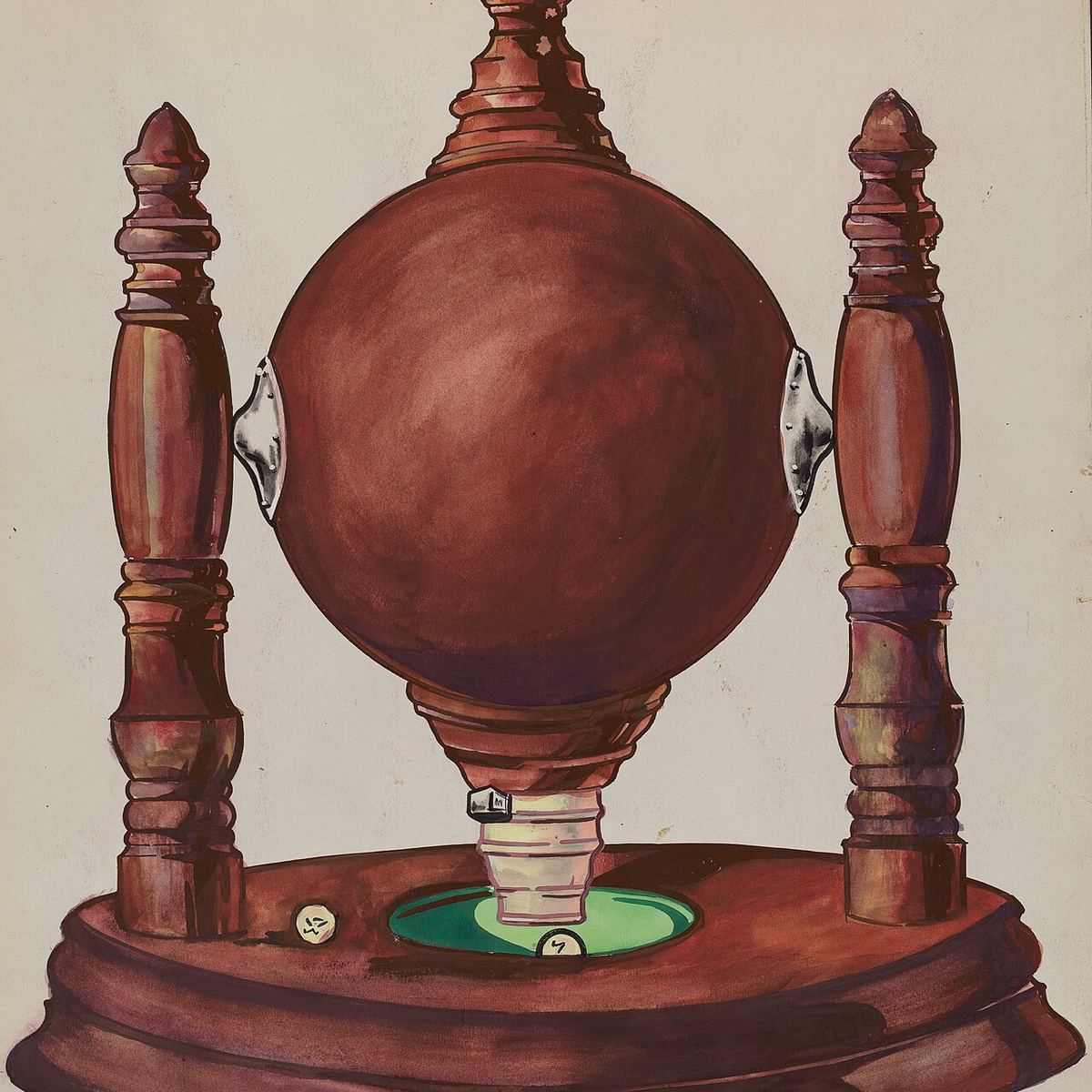
A keno goose, the wooden ball-drawing device of early keno games; Index of American Design watercolour by Sebastian Simonet, c. 1936. Photo: Sebastian Simonet, CC0
On this page 7 sections
The draw that every figure comes from
The NSW Keno Rules, effective 23 February 2026, define a spot as a number chosen from 1 to 80, and each game draws 20 winning numbers. The rules allow entries of 1 to 10 spots, plus 15, 20 and 40. The Victorian rules on the same site carry the same schedule of prizes for the $1 game, so the figures below apply in both states.
Our earlier piece on practical keno tips covers how to play and manage a session. This one is pure arithmetic: what the odds are, and what the prize table pays against them.
The counting rule behind keno odds
Keno is a hypergeometric problem. If you pick n spots and want exactly k of them among the 20 drawn, the number of ways it can happen is:
ways = C(n, k) x C(80 - n, 20 - k)
Divide by the total number of possible draws, C(80, 20), and you have the probability. C(a, b) is the count of ways to choose b items from a. The total is a big number: C(80, 20) = 3,535,316,142,212,174,320.
Worked example: the 10-spot jackpot
- Choose the 10 spots. To catch all 10, all of your numbers must be among the 20 drawn. There is C(10, 10) = 1 way to do that with your numbers.
- Fill the other 10 drawn numbers. They must come from the 70 numbers you did not pick: C(70, 10) = 396,704,524,216 ways.
- Divide by every possible draw. 396,704,524,216 / 3,535,316,142,212,174,320 = 0.0000001122.
- Turn it into "1 in X". 1 / 0.0000001122 = 8,911,711. So a 10-spot catches all 10 about once in 8,911,711 games.
The same method gives the full 10-spot picture, with the prize per $1 from the Regular Keno schedule in rule 18(b).
Chance of each catch on a 10-spot and the prize the schedule pays for it.
| Numbers caught | Probability | About 1 in | Prize per $1 |
|---|---|---|---|
| 0 to 3 | 78.80% | 1.27 | Nil |
| 4 | 14.73% | 6.79 | $1 |
| 5 | 5.14% | 19.44 | $2 |
| 6 | 1.15% | 87.11 | $5 |
| 7 | 0.161% | 620.68 | $50 |
| 8 | 0.0135% | 7,384 | $580 |
| 9 | 0.00061% | 163,381 | $10,000 |
| 10 | 0.0000112% | 8,911,711 | $250,000 plus jackpot components |
Notice that the most common prize, a catch of 4, only returns your dollar. Of the roughly 21% of games that pay anything, about 70% are that $1 refund.
Odds and returns for spots 1 to 10
Repeating the calculation for every spot size, using the $1 schedule. The return column is the long-run amount paid back per $1 from the fixed prizes alone.
Top-catch odds, any-prize odds and fixed-prize return by spot size.
| Spots | Top prize per $1 | Top catch, 1 in | Any prize, 1 in | Return per $1 |
|---|---|---|---|---|
| 1 | $3 | 4.00 | 4.00 | 75.0c |
| 2 | $12 | 16.63 | 16.63 | 72.2c |
| 3 | $44 | 72.08 | 6.55 | 74.9c |
| 4 | $130 | 326.44 | 3.86 | 74.1c |
| 5 | $675 | 1,551 | 10.34 | 74.8c |
| 6 | $2,000 | 7,753 | 6.19 | 74.7c |
| 7 | $5,000 + jackpot | 40,979 | 4.23 | Depends on jackpot |
| 8 | $25,000 + jackpot | 230,115 | 9.77 | Depends on jackpot |
| 9 | $100,000 + jackpot | 1,380,688 | 6.53 | Depends on jackpot |
| 10 | $250,000 + jackpot | 8,911,711 | 4.72 | Depends on jackpot |
The returns for spots 1 to 6 cluster around 75c. That matches the rules: for Regular Keno, the amount paid into the Keno Prize Fund is "75% of Subscriptions". For spots 7 to 10, part of the money goes to jackpot growth and the jackpot fill, so the fixed prizes alone return less (our sum for the 10-spot's fixed prizes, counting only the $250,000 base for 10 out of 10, is about 55.6c) and the rest of the value sits in a prize you have roughly a one in nine million chance of hitting.
One more pattern stands out. Spots 2, 5 and 8 have worse any-prize odds than the sizes either side of them, because the schedule starts paying at a higher catch. A 5-spot needs 3 numbers to win anything, while a 4-spot pays from 2; an 8-spot needs 4, while a 7-spot pays from 3.
Heads or Tails: three outcomes, two prices
Heads or Tails ignores your numbers and looks at where the 20 drawn numbers fall. Under the rules, the result is Heads when 11 or more are in 1 to 40, Tails when 11 or more are in 41 to 80, and Evens when the split is exactly 10 and 10. The schedule in rule 18(d) pays $2 for a winning $1 on Heads or Tails and $4 on Evens.
- Evens: C(40, 10) x C(40, 10) / C(80, 20) = 20.32%, about 1 in 4.92.
- Heads: (100% - 20.32%) / 2 = 39.84%, about 1 in 2.51. Tails is the same.
- Return on Heads or Tails: $2 x 0.3984 = 79.7c per $1.
- Return on Evens: $4 x 0.2032 = 81.3c per $1.
Both sit close to the 80% Keno Prize Fund contribution that the rules set for Heads or Tails. The side game hands back more per dollar than the regular spots, but over many games it still costs roughly 19c to 20c in every dollar.
What "1 in X" does and does not mean
A chance of 1 in 8,911,711 does not mean a 10-spot is due after that many games. Each draw is independent, so the odds are identical on the first game and the millionth. It also does not mean you will hit it within that many tries: the chance of at least one full 10-spot catch in 8,911,711 games is 1 - (1 - 1/8,911,711)^8,911,711, which is about 63%. Over 1,000 games, the chance is about 0.011%.
The same logic applies to hot and cold numbers. The rules describe a draw of 20 numbers from 80 every game; past results do not enter the count. For how electronic draws are tested, see our explainer on random number generators, and for a comparison with table games, the piece on which games pay back the most.
Speed is the hidden cost
Victoria's regulator, the VGCCC, notes that keno "moves quickly, giving you little time to decide whether to play again before the next draw". A 25c loss per dollar is modest on one game and large across an evening of back-to-back draws. If keno has become hard to stop, the free Gambling Helpline on 1800 858 858 is open 24 hours a day, and our safer gambling page lists the services in each state.
Sources
Frequently asked questions
What are the odds of hitting all 10 numbers in keno?
With 20 numbers drawn from 80, the chance of catching all 10 of your 10 spots is C(70,10) divided by C(80,20), which is about 1 in 8,911,711.
Which keno spot gives the best return?
Using the $1 Regular Keno schedule, the fixed prizes on spots 1 to 6 return about 72c to 75c per dollar, with a 1-spot at 75c. Spots 7 to 10 return less from fixed prizes because part of the money funds jackpots.
What are the odds of Heads or Tails in keno?
Evens, a 10 and 10 split, happens about 20.3% of the time, or 1 in 4.92. Heads and Tails each happen about 39.8% of the time, or 1 in 2.51.
Does a number that has not come up for a while become more likely?
No. Every game draws 20 numbers from 80 afresh, so past results do not change the odds of the next draw.
Read next
 PokiesLightning Link and Dragon Link: How the Games WorkLightning Link and Dragon Link fill gaming rooms across the country, yet few punters know what the link actually is. We go through the Hold & Spin…
 Law & TaxHow to Run a Melbourne Cup Sweep by the RulesTwenty-four horses, twenty-four tickets and one envelope of cash. We worked through a sweep from ticket price to final payout, including what to do…
 Betting MathsPokies Payout Minimums in Every Australian StateEvery state sets a floor on how much a pokie must pay back, but that floor is measured over years of play, not over one visit. We line up the legal…
18+Order set by our editors; we earn a commission on sign-ups through partner links — how this works. Decide your budget and session time before you start.